
2026 Winner
BronzeTurnaround Strategy
RONA
"Mike chez RONA"
Sid Lee
"Mike chez RONA"
Sid Lee
CASE SUMMARY
For more than eight decades, RONA held a rare position in Quebec: not simply as a hardware retailer, but as a locally rooted institution. Founded in 1939 by Quebec hardware merchants who united in the face of a supplier monopoly, RONA became a symbol of self-determination, local pride and economic resilience, earning deep emotional loyalty and long-standing trust among generations of Quebecers.That bond fractured when RONA was acquired by the U.S.-based Lowe’s. While the transaction reshaped the business structurally, its impact in Quebec went far deeper than ownership. Lowe’s undertook restructuring efforts that led to more than 30 store closures across Canada, with Quebec bearing a disproportionate share.
These closures were felt not only economically, but culturally, undermining perceptions of RONA as a Quebec-anchored brand and signaling a growing disconnect with the province where the brand’s identity had been rooted. Failure to act quickly risked accelerated loyalty erosion in Quebec (the province that historically anchored RONA’s strength) and increased vulnerability to local competitors.
RONA entered a pivotal new chapter when Lowe’s Canada was sold to Sycamore Partners, returning the brand to independent, Canadian-operated ownership.
To understand Quebecers is to understand a culture fundamentally distinct from the rest of Canada. One where the preservation of the French language is not merely functional, but foundational to identity, belonging and pride.
In Quebec, language is culture. Brands are judged not by what they sell, but by whether they demonstrate unmistakable cultural fluency through shared references, expressions, humour and inside jokes that are deeply rooted in the province’s collective memory and understood by fellow Quebecers.
Quebecers value brands that show genuine local connection, not surface-level localization. For RONA to meaningfully reconnect with Quebec’s DIY and PRO audiences, it needed to engage through these precise linguistic cues and cultural nuances, showing up the way Quebecers do, or risk continuing to be disconnected in the province.
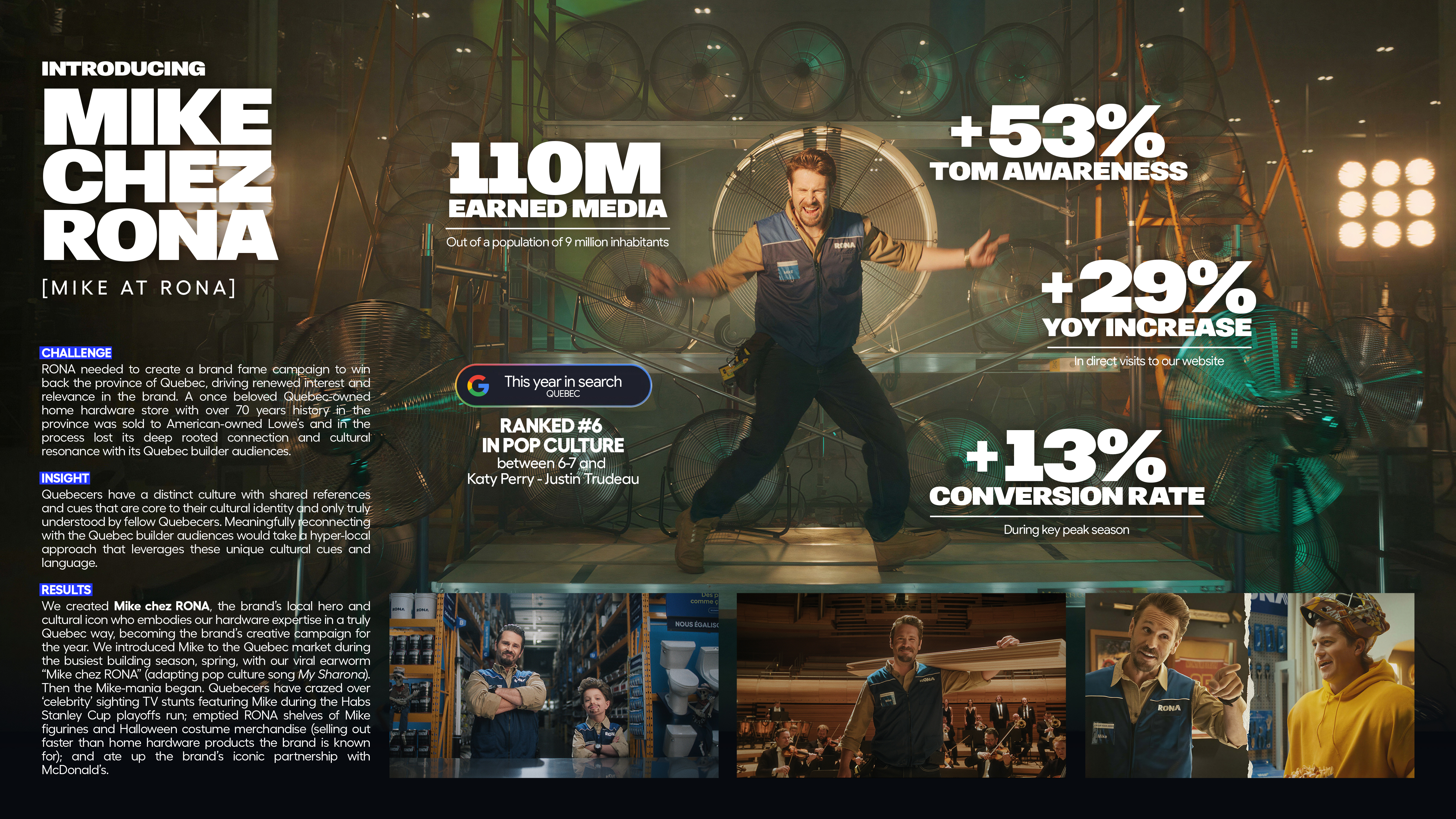
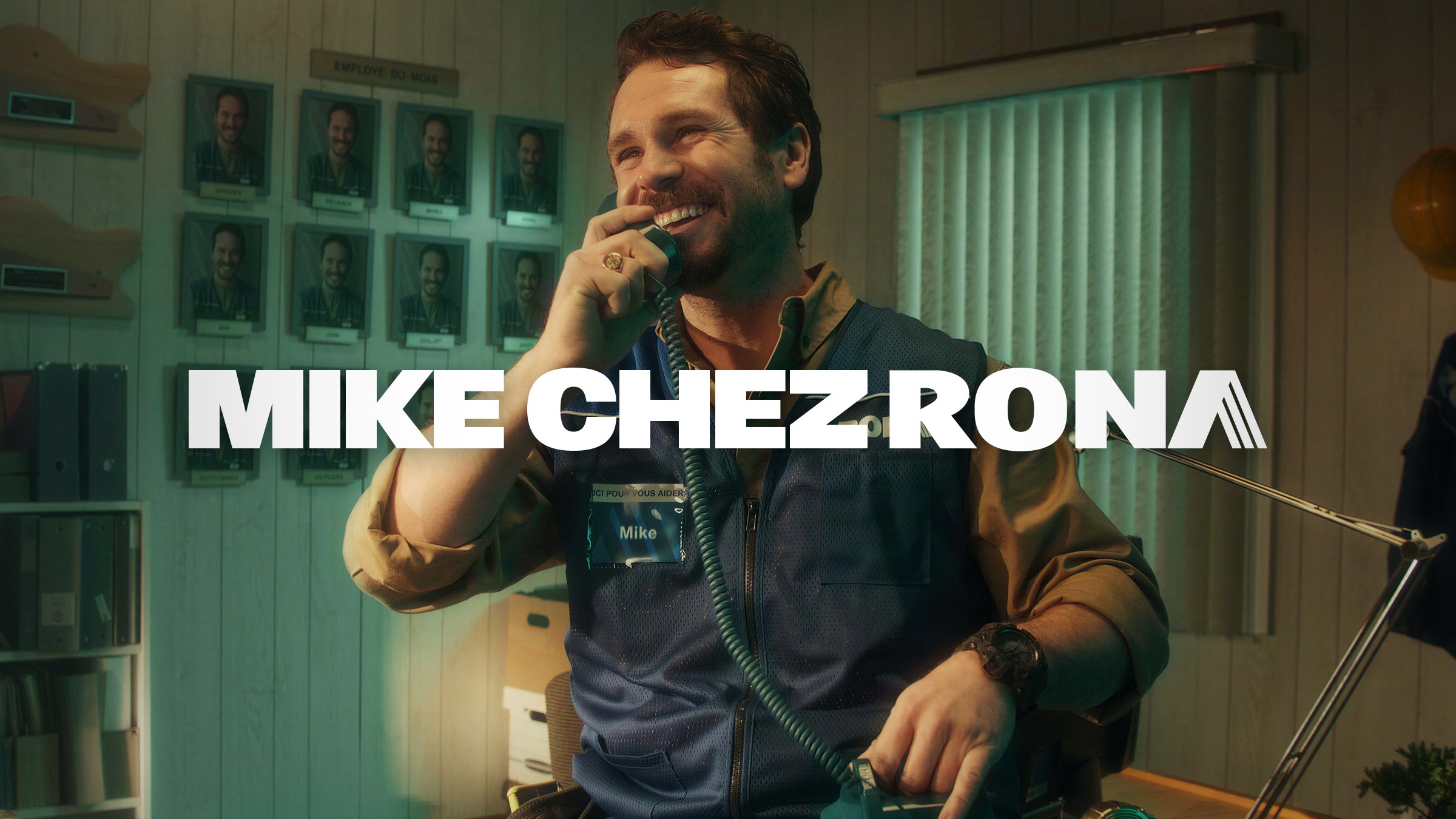
The agency created “Mike chez RONA”, the brand’s local hero embodying expertise in a truly Quebec way. The campaign launched with a reinterpretation of the hit 1970s rock song “My Sharona,” based on a Quebec mondegreen deeply embedded in collective memory and only truly understood by fellow Quebecers.
The strategy was activated through a fully integrated rollout designed to embed “Mike chez RONA” into Quebec’s cultural ecosystem. The campaign launched across television, radio, out-of-home, social, partnerships and PR to establish immediate scale and familiarity, with TV and radio prioritized early to reflect Quebecers’ media consumption habits and rapidly build awareness and trust.
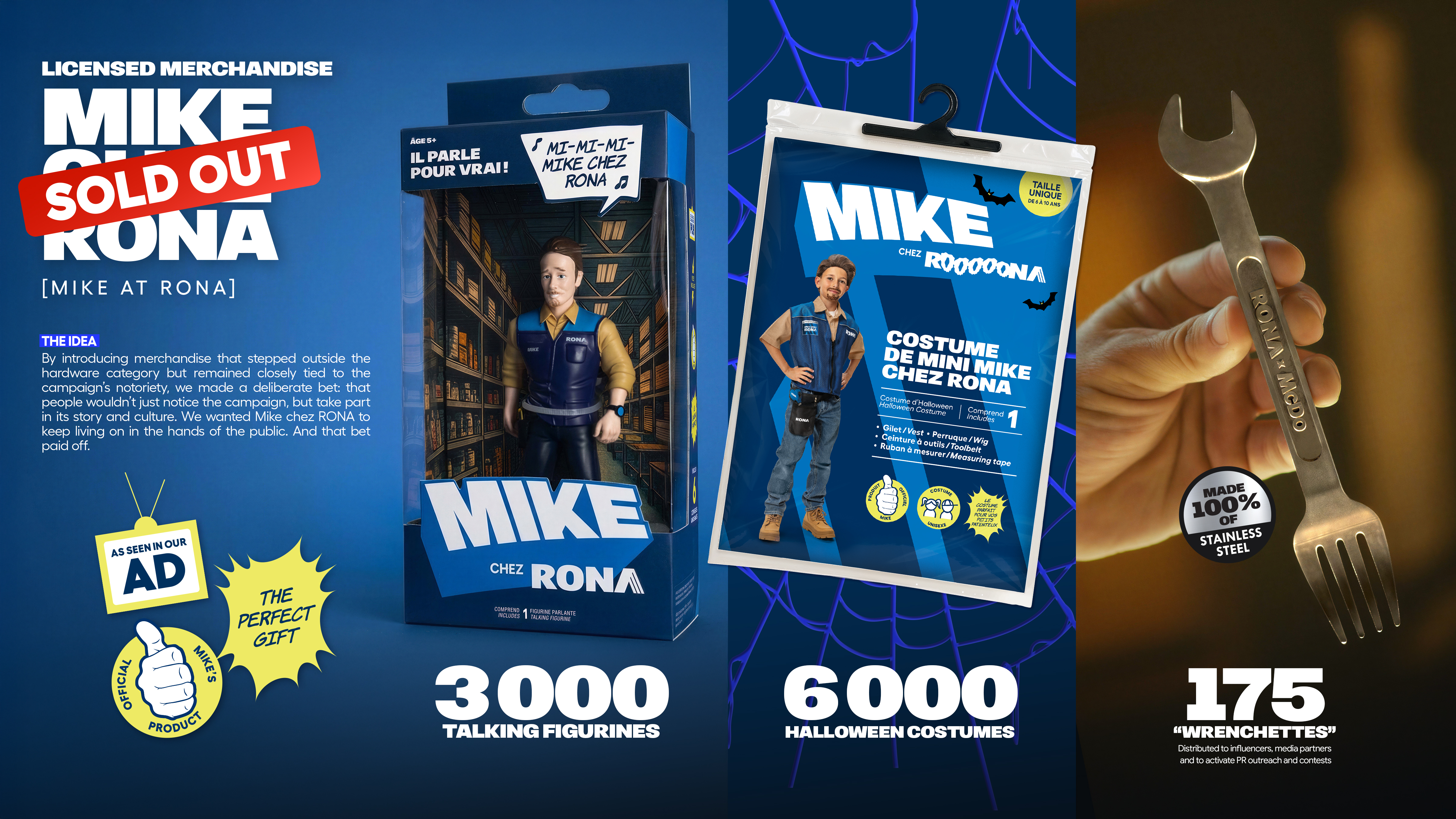
Mike seamlessly crossed cultural territories, appearing in TV integrations during NHL playoffs, hijacking a McDonald’s poutine commercial with the iconic “Wrenchette,” and moving naturally across renovation, food, sports and entertainment media. The character extended into physical culture through “Mike chez RONA” Halloween costumes and talking Mike figurines during the holidays, reinforcing adoption beyond advertising.
Mike ranked in Quebec’s top 10 pop-culture phenomena, appearing in Google Trends’ 2025 between Katy Perry & Justin Trudeau and TikTok’s viral 6-7 meme. Mike was adopted into Quebec cultural mainstream, featured in Tout le monde en parle and the New Year’s Bye Bye sketches, reinforcing cultural relevance.
Strategic planning was the defining force that elevated this work from a brand campaign to a sustained cultural re-entry for RONA in Quebec. Planning reframed the challenge from a communications problem to a legitimacy problem: RONA did not need louder messaging, it needed to relearn how to behave like a Quebec brand in a culture where relevance is earned through fluency. This reframing fundamentally shifted the way the agency approached creativity, media and execution in the work.
Planning also shaped how the campaign evolved over time. Rather than locking into a static plan, they built an adaptive framework where audience response informed where and how Mike appeared next. This allowed the work to stay culturally current and amplify organic momentum, sustaining relevance for months.
The campaign did not simply generate attention, it re-embedded RONA into Quebec culture at a time when the brand had lost its cultural significance in the province.
Quebec consumer perceptions to drive year-over-year growth in direct website traffic and increase conversion rates during the key spring peak season versus 2024. RONA achieved a 29% year-over-year increase in direct visits to the website and a 13% conversion rate during the key peak season in 2025.
RONA became default home improvement retailer for Quebec pro and DIY audiences by becoming the first brand they recall. The campaign achieved higher year-over-year top-of-mind awareness scores. RONA achieved 53% (17 to 26) top-of-mind awareness among the Quebec pro audience.
Win consumer loyalty in the province of Quebec. KPI: Achieve greater overall net promoter scores from 2024 to 2025. Result: Achieved greater overall net promoter scores compared to benchmarks: pro moved from 17 to 28 (Q2 2024 versus Q3 2025) and DIY moved from 6 to 23 (Q4 2024 versus Q3 2025)
Make RONA unmissable in Quebec by driving higher social engagement than previous campaigns.
The campaign generated 1 million social media engagements and sold out bespoke “Mike chez RONA” merchandise with 6 thousand in Halloween costumes and 3 thousand in figurines.
Breakthrough in Quebec culture and pop culture through earned media impressions. The campaign generated 110 million earned media impressions with coverage across print, broadcast, and online media in Quebec. The campaign was listed in Google’s top-10 Quebec pop-culture references for 2025.
Credits
AGENCY: Sid Lee* David Allard, Executive Creative Director
* David Lambert, Creative director
* Christian Jomphe, Art director
* Félix-Antoine Brunet, Art director
* Simon Blaquière, Copywriter
* Olivier Goulet-Lafond, Copywriter
* Quentin Fachon, Copywriter
* Thalie Poulin, VP, Accounts Services
* Valérie Roy, Account Director
* Gabrielle Crépeau-Hubert, Acount Executive
* Sylvie Crête, Account Director
* Laurence Dallaire, Acount Executive
* Shereen Ladha, North America Strategy Lead
* Chloe Hutchison, Strategy Director
* Jean-Claude Kikongi, Head of strategy
* Nicolas Dumitru, Strategist
* Vanessa Gervais, Executive Producer
* Marie-Soleil Patry, Executive Producer
* Alexandra Michaud, Producer
* Joannie Tellier, Producer
* Philippe Tremblay-Perrin, Post-production producer
* Emma Rozenblum, Production coordinator
* Amélie Duplessis-Tellier, Content manager
* Laetitia Harty, Director, PR and influence marketing
* Émilie Perreault, Account manager, PR and influence marketing
* Marie-Lise Campeau, Global President and CEO
* Johan Vakidis, President and Chief Creative Officer, North America
CLIENT: RONA
* Catherine Laporte, Chief Digital and Marketing Officer
* Jacynthe Prince, Senior Director, Brand Marketing
* Myriam Bernier, Head, Brand Marketing, Advertising and Influence Marketing
* Veronique Legault, Marketing Specialist, Brands and Advertising
* Louis-Philippe Charland, Head of Media and Brand Strategy, Marketing
* Nathalie Mahé, Media Strategy Specialist, Marketing
* Caroline Hurtubise, Social Media and Influence Marketing Advisor
PRODUCTION COMPANY: Cinélande
* Didier Charette, Director
* Sophie Gérard, Executive Producer
* Olivier Guillemette, Offline Editor
POST-PRODUCTION COMPANY: Arketype (Online Editing and Color Grading)
MEDIA AGENCY: Cossette Média
SOCIAL MEDIA AGENCY: Substance
For submission inquiries, please contact strategyawards@brunico.com
.
For partnership inquiries, please contact Neil Ewen at newen@brunico.com.
For partnership inquiries, please contact Neil Ewen at newen@brunico.com.