
2026 Winner
BronzeData Driven Strategy
Popeyes
"Pickle Quest"
McKinney
"Pickle Quest"
McKinney
CASE SUMMARY
The QSR landscape in Canada has been getting increasingly saturated, and brands are constantly competing for share of wallet with limited-time offers and flavour innovations.When Popeyes launched its niche “All-Pickle Menu”, they knew it would be polarizing: people tend to either love or hate pickles. In QSR, polarizing is perfect, because passion generates buzz and interest. So how could the agency bypass generic audiences and culturally connect with the “pickle-obsessed”?
Traditional broad-reach targeting would be too blunt a tool; they needed to reach the pickle-lovers without wasting impressions on the indifferent.
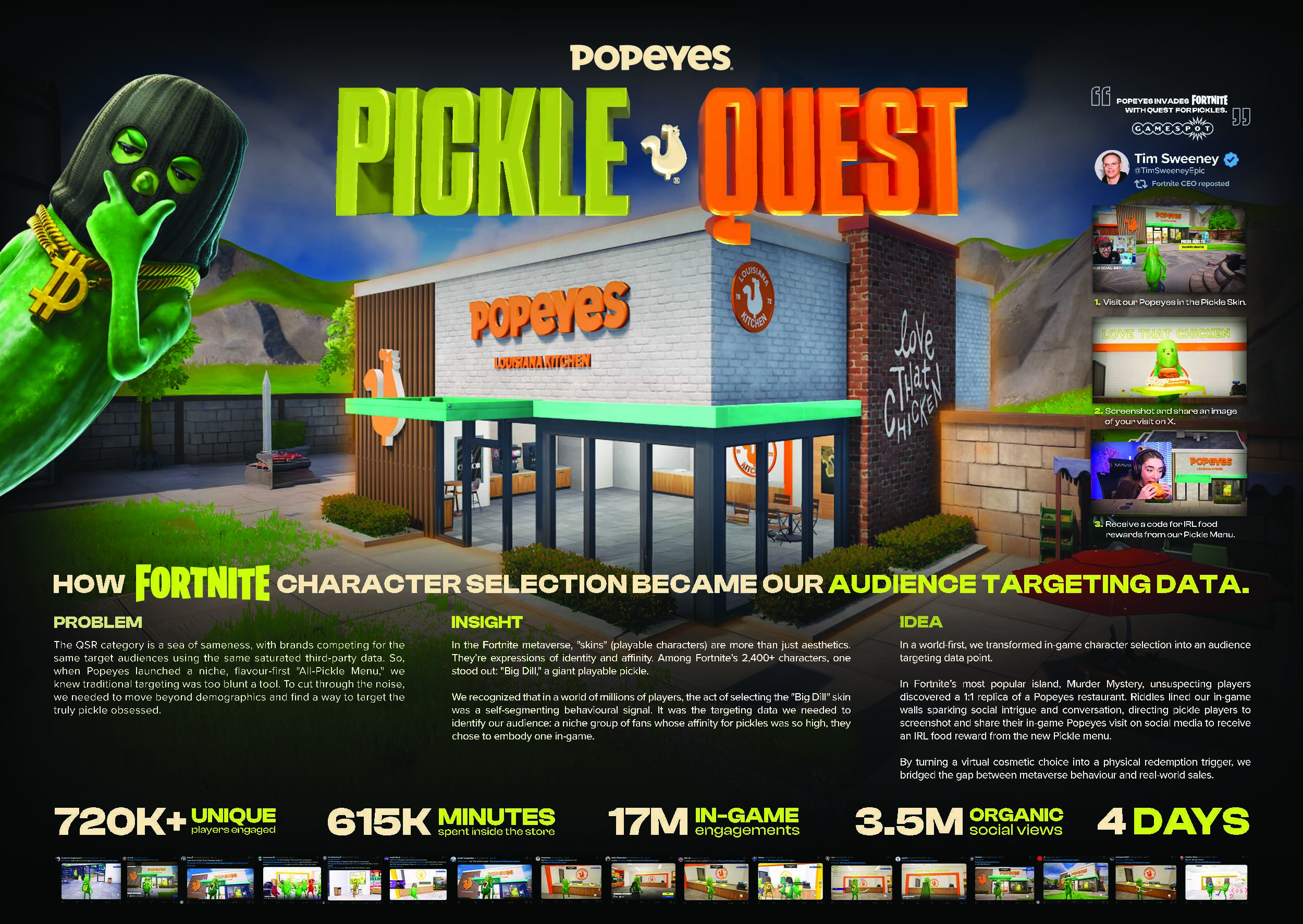
Enter Fortnite, a niche and unexpected source of audience targeting data. A culture-defining gaming platform with millions of players, Fortnite had just released “Big Dill” in February 2025, a giant playable pickle character (also known as a ‘skin’), adding it to its catalogue of over 2,500 unique skins.
In gaming culture, skins aren’t just cosmetic choices; they’re expressions of identity and affinity. Players who choose to embody a pickle in-game were sending us a giant signal that they’re pickle-lovers – a data insight that had us salivating.
They became the first brand to treat in-game character selection as a behaviour targeting filter to isolate and directly reach their niche audience.
Partnering with Good Gamers, a celebrated team of Fortnite creators, they built a new Popeyes restaurant in Murder Mystery, one of the game's most popular islands with an audience of over 200,000 daily players. Instead of building their own branded island, they went directly to where players already were.
Unsuspecting Murder Mystery players discovered the 1:1 replica of a Popeyes restaurant. With little context, they ventured inside to discover riddles on its walls: “Pickles get pickles,” and “Picture yourself a pickle.” Players immediately took to social and discussion forums to share their discoveries and form theories. A fleet of Fortnite influencers helped put the pieces together, revealing the details of the quest: any player who enters the Popeyes in the pickle skin and shares a photo of their visit on X will receive a food reward from Popeyes’ new Pickle Menu.
Once the “Pickle Quest” was revealed, intrigue turned into mayhem with a flood of user-generated content. Over the course of four days, in-game pickles visited the restaurant, screenshot their visit, and shared it – rewarding the pickle-loving human behind the controls.
The agency built a 1:1 replica of a Popeyes restaurant as a cultural hub for their niche audience.
They deployed an in-game quest accessible to players wearing the "Big Dill" skin, ensuring audience relevance.
Players decoded in-game riddles and shared "proof of visit" photos to social media, driving UGC and deepening the reach.
This social verification triggered a direct-to-consumer digital coupon, turning a niche virtual behaviour into a physical QSR transaction.
The unlock was the strategic shift from the typical move of “buying audiences” to catching superfans at a peak moment of publicly proclaiming their passion for pickles. Recognizing metaverse skins as a new form of first-party data became a distinct value-add. Tapping into this cosmetic game choice as a high-intent targeting filter, Planning provided a “Precision Playbook” that allowed a mass-market brand to unexpectedly achieve 1:1 relevancy. This strategy eliminated waste media, established a new methodology for Popeyes to identify and reward “super-fans” within any subculture, and drove unfair attention for the brand.
The results speak for themselves, proving the strategic power of niche precision to drive mass impact. Successfully identified and converted a niche audience traditional data couldn't reach. 720,851 players engaged, spending more than 617,000 minutes combined inside the branded environment. The campaign garnered more than 7.1 million in-game engagements and more than 3.5 million organic social views.
They proved that the future of audience targeting lies in creatively leveraging unique behavioural signals that already exist in digital environments. By treating in-game character selection as a unique data point, they unlocked a specific audience based on their interests as expressed through their virtual cosmetic choices.
Credits
Omid Amidi, Co-Chief Creative Officer, McKinneyLyle Yetman, Co-Chief Creative Officer, McKinney
Caleb McMullen, Associate Creative Director, McKinney Canada
Hussein Rumaithi, Associate Creative Director, McKinney Canada
Melanie Wallace, Account Director, McKinney
Macarena Marcos, Strategy Director, McKinney
Warren Goodwin, Editor, CYLNDR Studios Canada
Daisy Qin, Strategy Director, McKinney Canada
John Pace, Executive Director, McKinney Canada
For submission inquiries, please contact strategyawards@brunico.com
.
For partnership inquiries, please contact Neil Ewen at newen@brunico.com.
For partnership inquiries, please contact Neil Ewen at newen@brunico.com.