
2026 Winner
GoldB2B Strategy
SilverCause/Public Service
Women's Shelters Canada
"Refer Her"
LG2
"Refer Her"
LG2
CASE SUMMARY
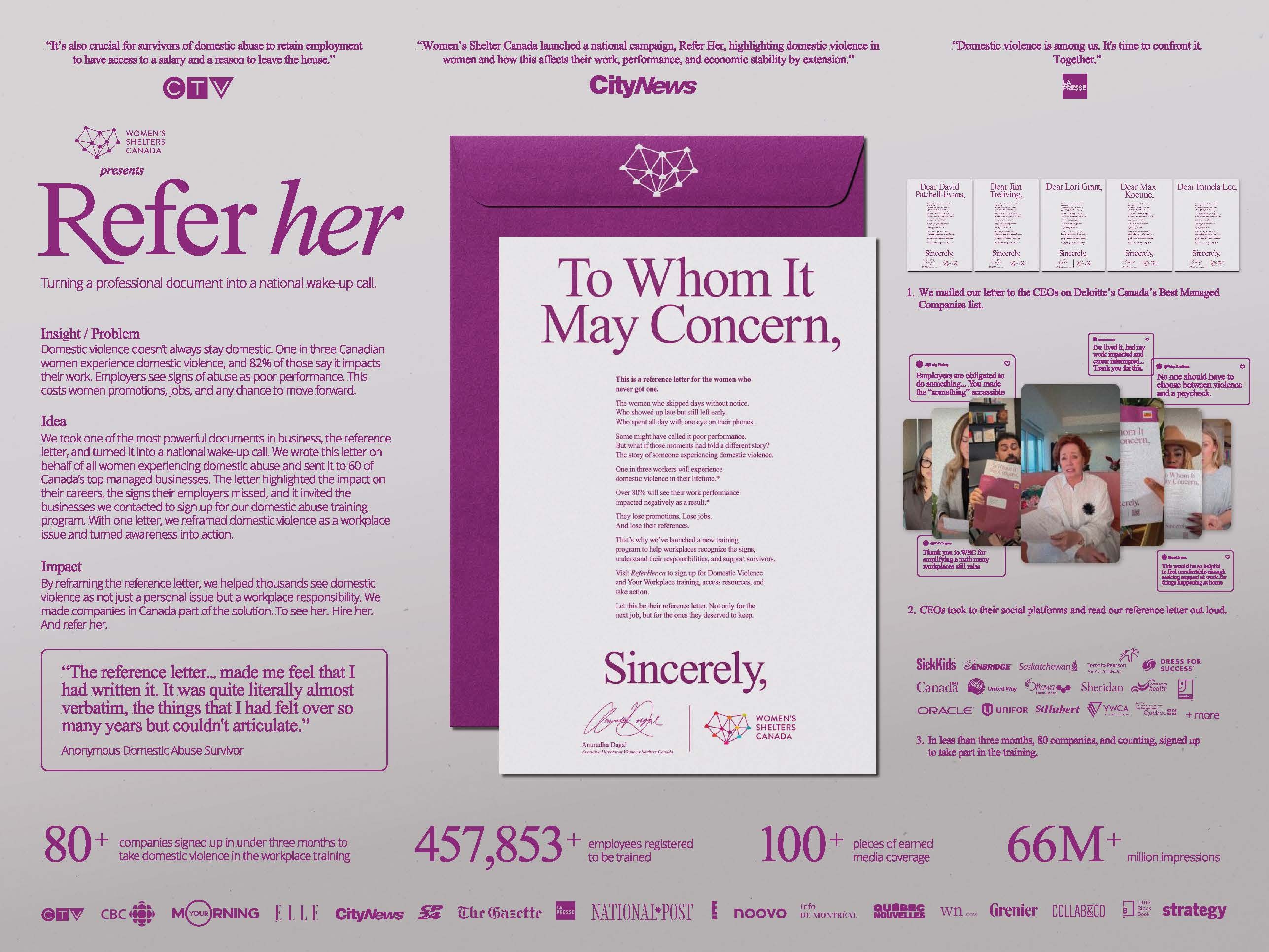
Since the signs of domestic violence are often invisible at the office, their objective was to not only make businesses aware of the issue, but also to get them to commit to action by signing up for their training program.The agency needed to reach businesses in a way they couldn’t ignore. So we took a professional document that every business values – a reference letter – and turned it into a national wake-up call, encouraging businesses to learn how to support their employees through their training.
As CEOs publicly shared the letter, they reached millions of Canadians and exceeded their training registration goal by 700%. Most importantly, “Refer Her” impacted those directly affected, as it empowered survivors to seek support in their own workplaces.
With one letter, they reframed domestic violence as a workplace issue.
Domestic violence is an epidemic in Canada that is hiding in plain sight. One in three women have experienced some form of physical and/or sexual violence by their intimate partner.
But Canadians don’t realize the full extent of the issue. Of those affected, 82% find their work performance suffers, and signs of violence – lateness, missed shifts, and decreased focus – are routinely believed to be poor employee performance. As a result, women lose promotions, jobs, references, and, above all, a chance of escaping violence.
For survivors, silence is the greatest barrier to safety. WSC developed its Leading Change program to provide the necessary training, but with corporate blindness at an all-time high, sign-ups were stalling. As the return to office movement gained momentum post-pandemic, the risk for women suffering in silence intensified.
They didn’t just want to shine a light on the issue, they wanted to operationalize protection by encouraging Canadian businesses to stop ignoring the issue and commit to real, measurable action by enrolling in professional training.
To do that, they needed a campaign that would make domestic violence impossible for Canadian businesses to keep ignoring.
Through desk research, WSC’s research, and interviews with survivors and everyday Canadians, they uncovered three realities that shaped the strategic thinking:
1 in 3 women experience domestic violence. This made the prevalence of the issue abundantly clear, challenging the perception that it “doesn’t happen to people I know.”
82% of women report seeing their work suffer as a result of the abuse. This led them to the insight that domestic violence doesn’t just stay at home.
Organizations misinterpret these signs as poor performance. This led to the breakthrough moment: they realized if they didn’t shine a light on domestic violence in the workplace, businesses would continue to ignore it and not take action.
With this strategic planning, they had their key insight: domestic violence doesn’t stay domestic.
With businesses unaware of how domestic violence shows up in the workplace, they needed a way to cut through their ignorance.
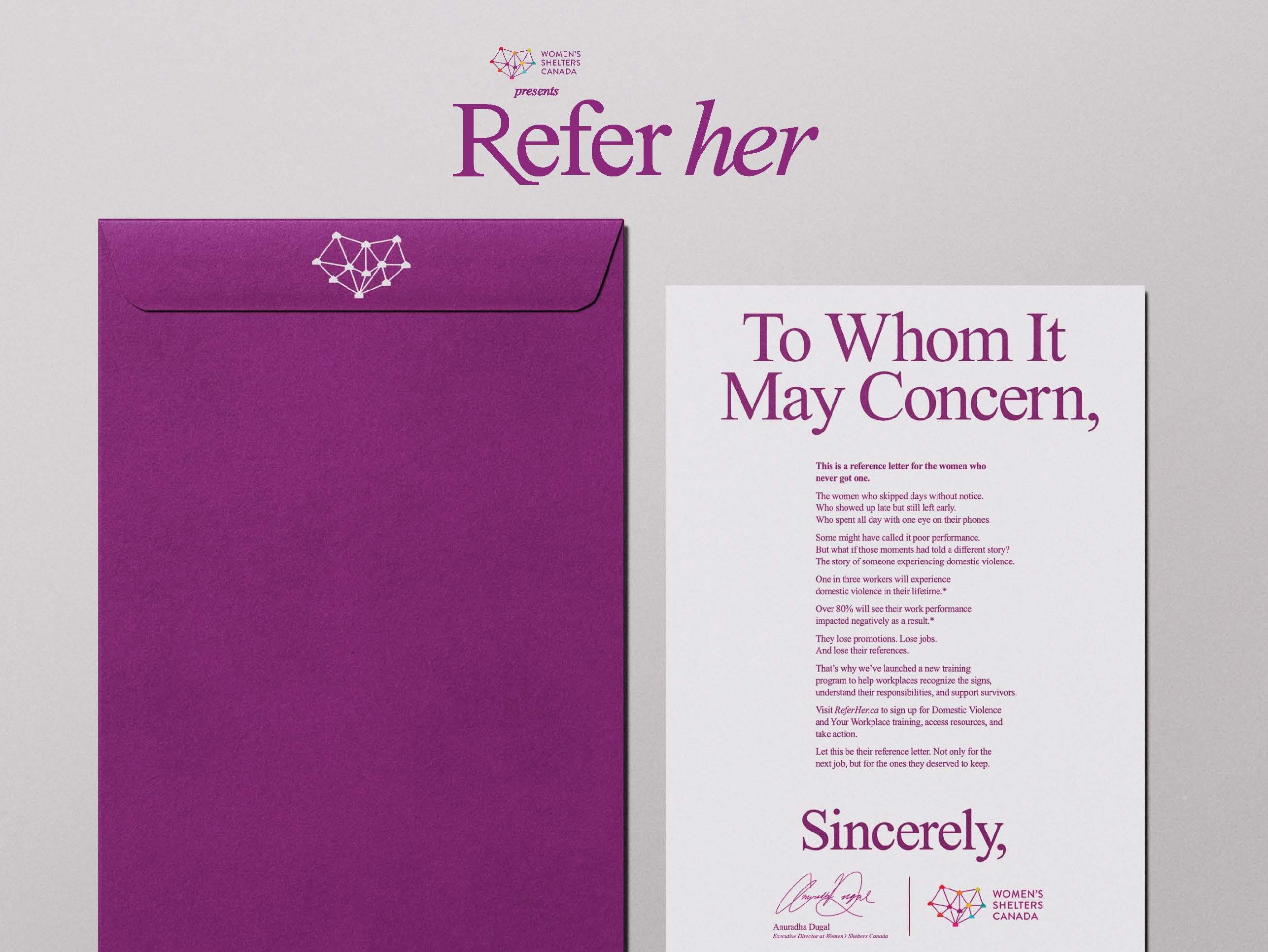
The creative idea was to shine a light on the issue by putting it in a document that businesses never ignore: a reference letter.
With “Refer Her,” they wrote a reference letter for all of the women who never received one and sent it to Canada’s top businesses. The letter showed how missed days and absentmindedness are not just poor performance but could very well be signs of domestic violence showing up in the workplace.
The letter recommended businesses to sign up for their Leading Change training and learn how to spot the signs and better support their employees. But it wasn’t just meant to raise awareness: they created “Refer Her” to bridge the gap between employer ignorance and survivor experience by equipping companies with the tools to identify the subtle signals of domestic violence.
To reach those who could potentially make the most impact, they sent the reference letter directly to the CEOs of Canada’s top businesses, inviting them to sign up for training. They also sent it to CEOs with significant social media presence, inspiring them to read the letter aloud on their platforms and share the message with their networks.
They then shared the campaign on LinkedIn to appear in feeds of CEOs, HR leaders, and recruiters, inviting them to amplify the letter with their own professional networks and reach even more Canadians.
With one letter, they reframed the issue and showed Canadians that domestic violence is not just a personal issue, it’s a workplace responsibility.
The reference letter delivered against their objectives, exceeding expectations on every level.
The campaign garnered 100 earned media placements across TV, print, and digital, including national morning shows and major Canadian publications as well as over 66.2 million impressions and over 77.6 million in reach.
CEOs shared the letter on social channels and called on peer organizations to sign up for the training Objective: Change consumer behaviour
To date, about 80 companies have signed up to take the training, all within three months of the campaign launch, beating their goal by 700%.
Over 450,000 employees across Canada registered to be trained and survivors reached out to share how the campaign validated their experience and empowered them to ask their workplaces for support
They made businesses part of the solution, so the next time a survivor needs a reference, they will refer her.
Credits
LG2Women’s Shelters Canada
Fela TV
Post: Saints Editorial, Darling Colour & VFX
Sound: Grayson Music
Media: Dialekta
Pragency: Alinea, Hyper PR
Website: BLVD Agency
Research Survey: Citizen Relations
Printing: Transcontinental Printing 2005 GP
CD, Josh Stein
CW, Manrupe Virk, Verity Badov
AD, Livy Morden
Strategy, Nikole Patterson-Hurst
Client Services, Casey Mendoza, Genevieve Ti, Anna McDonald
Production, Tara Greguric, Erin Popadynetz, Christine Malacas
Mac Artists, Briar Koski
Eng Proofreader, Linda Matassa
FRE CD, Joannie Fredette
French CW, Maude Delisle Blackburn, Clohé Boucher, Juliette Patenaude
French Translator / Proofreader, Léa-Marie Paiement, Maude Labelle, Anna Verma
CCO, Josh Stein, Luc Du Sault, Nicolas Baldovini
CSO, Sophie-Annick Vallée
VP, executive CD, Ryan Crouchman
VP, strategy, Keith Barry
FELA
Exec Producer, Taj Chritchlow
COO, Dean rosen
HOP, Amir Karimi
Director, Kat Webber
DOP, Antonia Ramirez
Integrated Producer, Mikayla Fasullo
Line Producer, Amber Warus
Saints
Exec Producer, Emily McKay
Producer, Phoebe Lorimer
Edit, Julie Simmons
Darling VFX
Exec Producer, Kristen Van Fleet
Producer, Joelle Aani
Colourist, Kassi Bellamy
Colour Assistant, Eric Kingsbury
Online/VFX, Alyssa Schmidt
VFX Assistant, Erica Bradbury
Grayson Music
Sr Producer: Clare McGonigle
Music Director: Ali Willa Milner
Audio Engineer: Eric Hulme
Sound: Ben Swarbrick
Music Supervisor: Rich Hamilton
Photographer
Juliia Christ
Dialekta
Marie-Pier Haineault, Sr Media Strategist
Nicolas Peron, Assistant Media Strategist
Alinea
Donna Battista, Sr Director
Hype PR
Erin Richards, Founder & Lead Publicist
Jeff Ruben, Account Director, Transcontinental Printing 2005 GP
Norman Mayot, Partner, Website
Michelle Arbus, Director Intelligence & Insights
Sarain Fox, Talent
WSC
Anuradha Dugal, Executive Director
Kaitlin Geiger-Bardswich Director of Communications and Advocacy
Lynn Medi, Communications Manager
For submission inquiries, please contact strategyawards@brunico.com
.
For partnership inquiries, please contact Neil Ewen at newen@brunico.com.
For partnership inquiries, please contact Neil Ewen at newen@brunico.com.