
2026 Winner
GoldTech Strategy
Electronic Arts & Battlefield Studios
"BATTLEFIELD 6: Destruction Receipts"
Sid Lee
"BATTLEFIELD 6: Destruction Receipts"
Sid Lee
CASE SUMMARY
In 2025, Battlefield was a franchise in crisis. After consecutive underperforming launches, brand trust had hit an all-time low, and the series had lost its leader status. To the gaming community, Battlefield’s signature feature, destruction, had become visual white noise – underwhelming and meaningless to play.The agency discovered fans loved to flex their gameplay online, valuing receipts, the digital demand for objective proof to validate their personal gameplay stories. They realized that if they could quantify the chaos, they could turn every player into a proud spokesperson for the game.
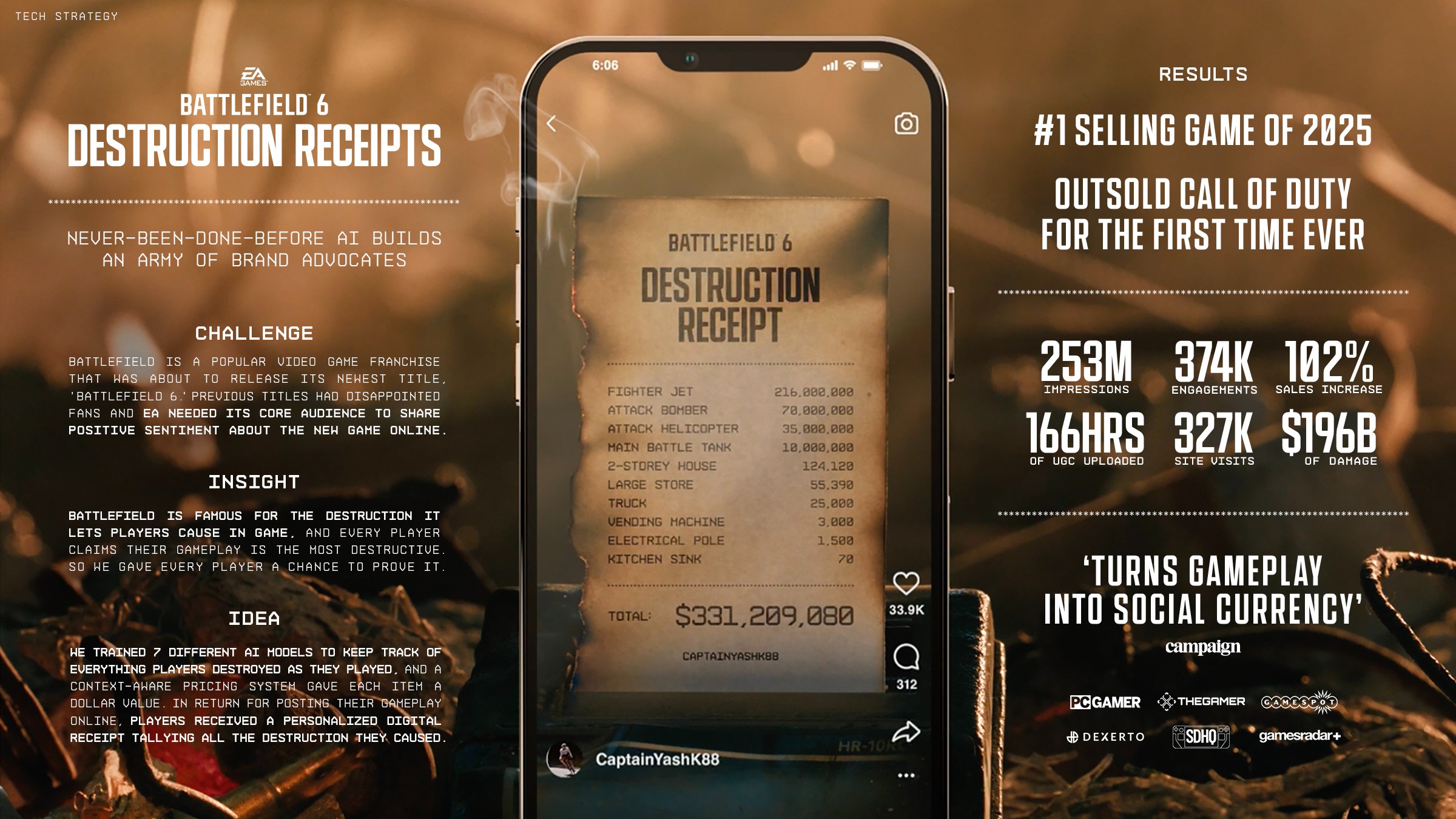
They created and deployed a custom AI model composed of seven different agents that scanned player-submitted gameplay clips and issued itemized "Destruction Receipts," validated by real-world architectural data, that "billed" players for the property damage they caused.
The core objective was to reclaim market leadership by winning back a skeptical, relapsed fan base. They faced three primary hurdles:
A trust deficit: Previous titles (like 2042) had launched with technical issues, leading to high levels of skepticism and criticism online amongst fans.
Destruction had become meaningless: In a saturated FPS market, and with previous lackluster titles, the game’s core element of destruction no longer felt special. They needed to move destruction from an aesthetic choice to a personal achievement.
A Goliath competitor: Call of Duty held a dominant market share. To beat them, they couldn't match their media spend, they had to out-innovate their player experience.
The agency created “Destruction Receipts”, building their own unique AI system that turned in-game destruction into a personalized “receipt,” itemizing the cost of every single item in the explosive new world of “Battlefield 6”. Whenever a player destroyed objects in the game and shared footage of their gameplay online, their AI system calculated every dollar of damage and sent them a “Destruction Receipt” to share and brag about their total damage caused, with the literal receipts to prove it.
In order to create our AI system, they first trained a vision model on Battlefield’s own internal map environments to recognize anything that could be destroyed during gameplay. They deployed seven specialized AI agents to process each clip of footage.
AI didn’t simply spot damage – it differentiated between light damage, heavy damage, and total destruction. It needed to be able to tell the difference between existing destruction and what a player actually caused, while understanding specific in-game locations like Brooklyn, New York instead of “urban centre.”
To make the destruction receipts as accurate as possible, they employed demolition expert and engineer Carlos Diemer, who assessed the realistic values of every destructible object found in the game’s playable maps. They also leveraged him in their social content to grab fans and deliver a heightened sense of legitimacy to the campaign.
The agency kept them engaged with content including unique game skins that unlocked when a certain dollar amount of damage was achieved, and immortalized the top 3 players by engraving their winning receipts in gold, silver, and bronze “Destruction Receipt trophies”, along with personalized letters signed by the game’s creators.
Strategic planning moved the brand launch from storytelling into a utility role. The distinct value added was the identification of “receipts culture,” the behavioural trend where younger audiences use data and "proof" to establish social hierarchy. This was happening within the gaming community online through various social/community platforms like TikTok, Discord, Reddit, and Twitch.
This insight redirected the creative ideation of the campaign away from traditional comms and toward the development of the AI Destruction mechanic. This helped them create the case for an advocacy gap within this category. While competitors fought for attention with cinematic trailers, planning recognized that skeptics of Battlefield would only trust peer-to-peer validation. By shifting the focus from brand-led claims to player-led audits, they turned a technical game feature into a competitive social engine.
The strategy achieved every planning goal and fundamentally altered Battlefield's go-to-market strategy.
Battlefield became the #1 Best-Selling AAA Game of 2025, successfully knocking Call of Duty off the top spot. Sales increased by 102%, more than doubling the launch volume of the previous title, while conversion power reached a 6.2% web-to-pre-order conversion rate, 24% above the industry benchmark.
The campaign generated 253 million impressions, driven primarily by organic shares of “Receipts”. Players submitted over 166 hours of UGC, more than 100 hours above the agency’s most ambitious KPI, 66% over target. Sentiment also reversed, with a 48% increase in positive brand sentiment, moving the needle from “skeptical” to “advocate.”
Credits
Global Chief Executive Officer, Marie-Lise CampeauPresident & Chief Creative Officer, North America, Johan Vakidis
Chief Creative Officer: Ali Stewart
Executive Creative Director: Matt Fraracci
Creative Directors: Tim Zimmerman, Alex Bird, Alex Pellerin
Art Directors: Tim Zimmerman, Alex Pellerin, Brennen Robinson
Copywriters: Alex Bird, Osman Rahmani, Andrea Cousineau
Head of Content: Jennifer Stack
Senior Content Creator: Erik Jorgensen
Content Creator: Gohar Salim
EVP, Client Partnerships, North America: Marianne Pizzi
Account Director: Yash Keough
Account Executive: Emma Tesch
VP, Head of Strategy, North America: Shereen Ladha
Group Strategy Director, Head of Strategy: Jean-Claude Kikongi
Senior Strategist: Nico Wlock
Strategist: Nicolas Dumitru
Strategy Analyst: Barbara Scheed
Head of Production: Jen Mete, Carolyne Goyette
Senior Producer: Sara Teasdale, Lauren Sloan
Production Coordinator: Tofunmi Awonaike, Emma Rozenblum
EVP, Innovation, Digital & Strategy: Yanick Bedard
VP, Digital Production: Ti-Leng Thang
CD & Innovation Lead, Digital Design: Jean-Francois Lavigne
Technical Director: Pascal St-Laurent
Senior Full Stack Developer: Louis Jutras
Lead Full Stack Developer: Maxime Gagne
Front End Technical Lead: Maxime Daoust
Lead Creative Developer: Patrick F. Mayer
Front End Developer: Jean-Philippe Robin
Senior Director: Pie-Luc Beaulieu
Senior Project Manager: Anne Simard
IT Tech: Simon Perras-Dyotte
UX Designer: Sophie LeBlanc
Production Designer: Tim Yule
Motion Designer: Noah Dauphinais
Assistant Editor: Hugo Dumas
QA Specialist: Mensada Brkan
Head of Resourcing: Kyra Cohen
Senior Creative Services Manager: Justin Hewitt
Electronic Arts & Battlefield Studios
VP, Global Communications: Tracey Thompson
Global Senior Director, Integrated Communications, Battlefield: Andy McNamara
Senior Director of Community & Social Media: Matt Grandstaff
Senior Manager, Social Media, Battlefield Franchise: Parker West
Manager, Social Media, Battlefield Franchise: Pete
For submission inquiries, please contact strategyawards@brunico.com
.
For partnership inquiries, please contact Neil Ewen at newen@brunico.com.
For partnership inquiries, please contact Neil Ewen at newen@brunico.com.