
2026 Winner

BronzeCreative Catalyst
BronzeDEI Strategy
Safehaven Toronto
"Becoming Visible"
The Local Collective
"Becoming Visible"
The Local Collective
CASE SUMMARY
Safehaven is one of the few organizations in Canada dedicated to children with medical complexity, children who rely on mobility aids, feeding tubes, or respiratory support to live.Canada sees itself as inclusive, especially in cities like Toronto. But medically complex children are still largely invisible in public spaces. They are cared for within systems, but rarely understood within every day life.
As CEO Susan Bisaillon put it, the goal is to "deinstitutionalize kids with complexities and bring them back into the community."
The challenge was to build awareness of inclusion while giving people the confidence to practice it in everyday life.
The insight came from a behaviour most parents recognize: "Don't Stare". When children encounter visible disability, their instinct is curiosity. They look, ask questions, and try to understand. But those moments are often interrupted with "don't stare." Over time, that guidance to look away teaches avoidance we stop seeing these kids.
Research reinforced this gap. While 95% of parents believe conversations about disability matter, 75% feel unequipped to guide them. The issue wasn't awareness, it was what happens in small, everyday moments when people don't know what to do.
Safehaven also recognized that this couldn't be solved through pity. In the charitable space, medically complex children are often framed through hardship, which can create more distance instead of connection. If inclusion was going to improve, people needed to feel more comfortable, not more guilty.
So, while awareness was the goal, the real barrier wasn't information. It was discomfort. Not the kind that comes from not caring, but from wanting to do the right thing and not knowing how.
This led to a clear strategic approach, first create a powerful public moment that reframes how people see medically complex children, then give families the tools to practice that behaviour in real life, and reinforce it at scale.
The campaign launched with "Invisible," a film built around a universal childhood truth. Every child imagines having a superpower. Invisibility is one of the most common. The film uses that familiar idea to create recognition. Children play, hide, and imagine disappearing in ways that feel joyful and relatable. Then the story shifts. We meet a medically complex child whose answer is different. He doesn't want to disappear. He wants to be seen. That contrast reframes the idea. Invisibility is not a fantasy for these children. It's something society has conditioned.
But awareness alone doesn't change behaviour. People still need to know what to do in real moments.
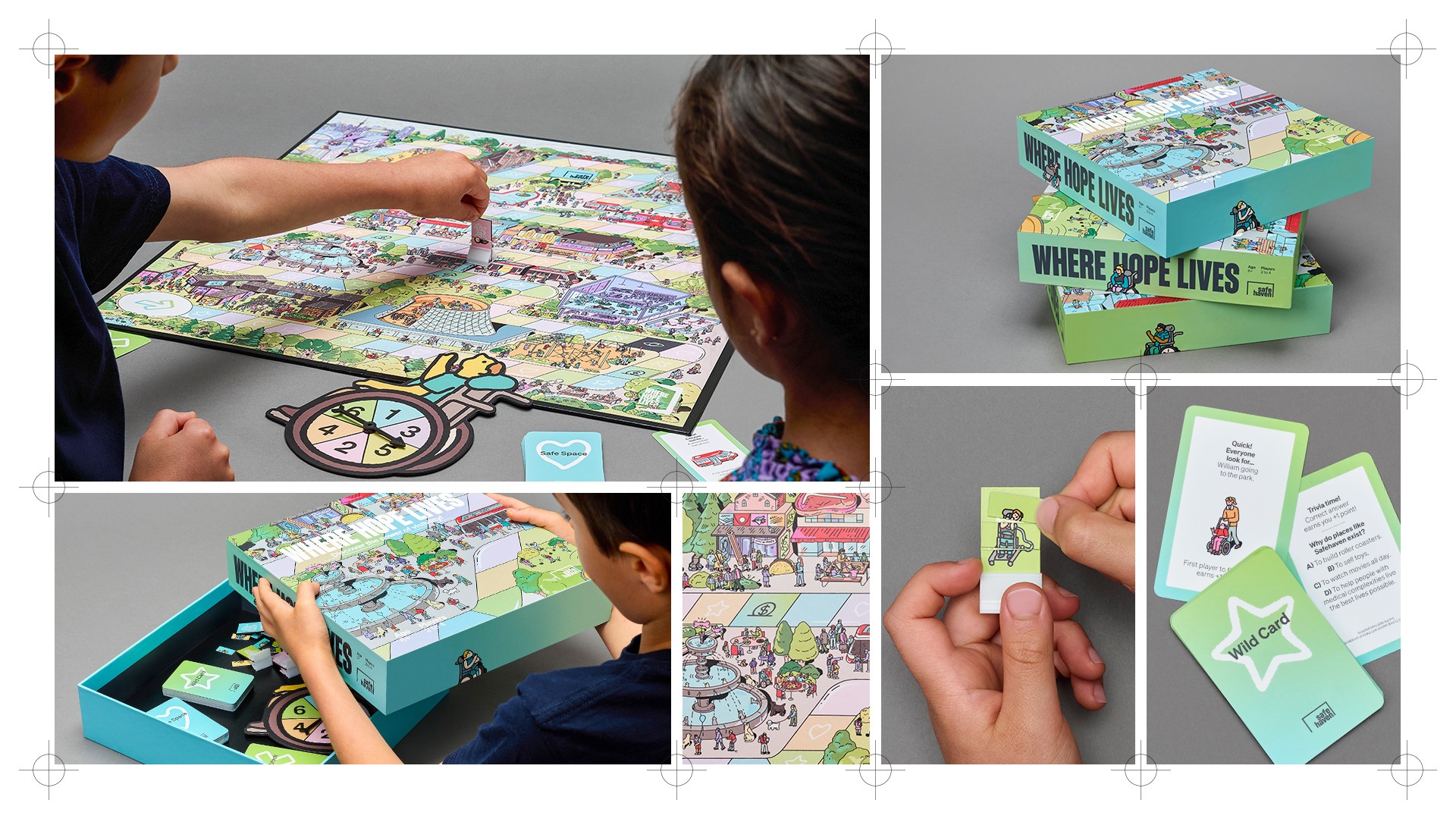
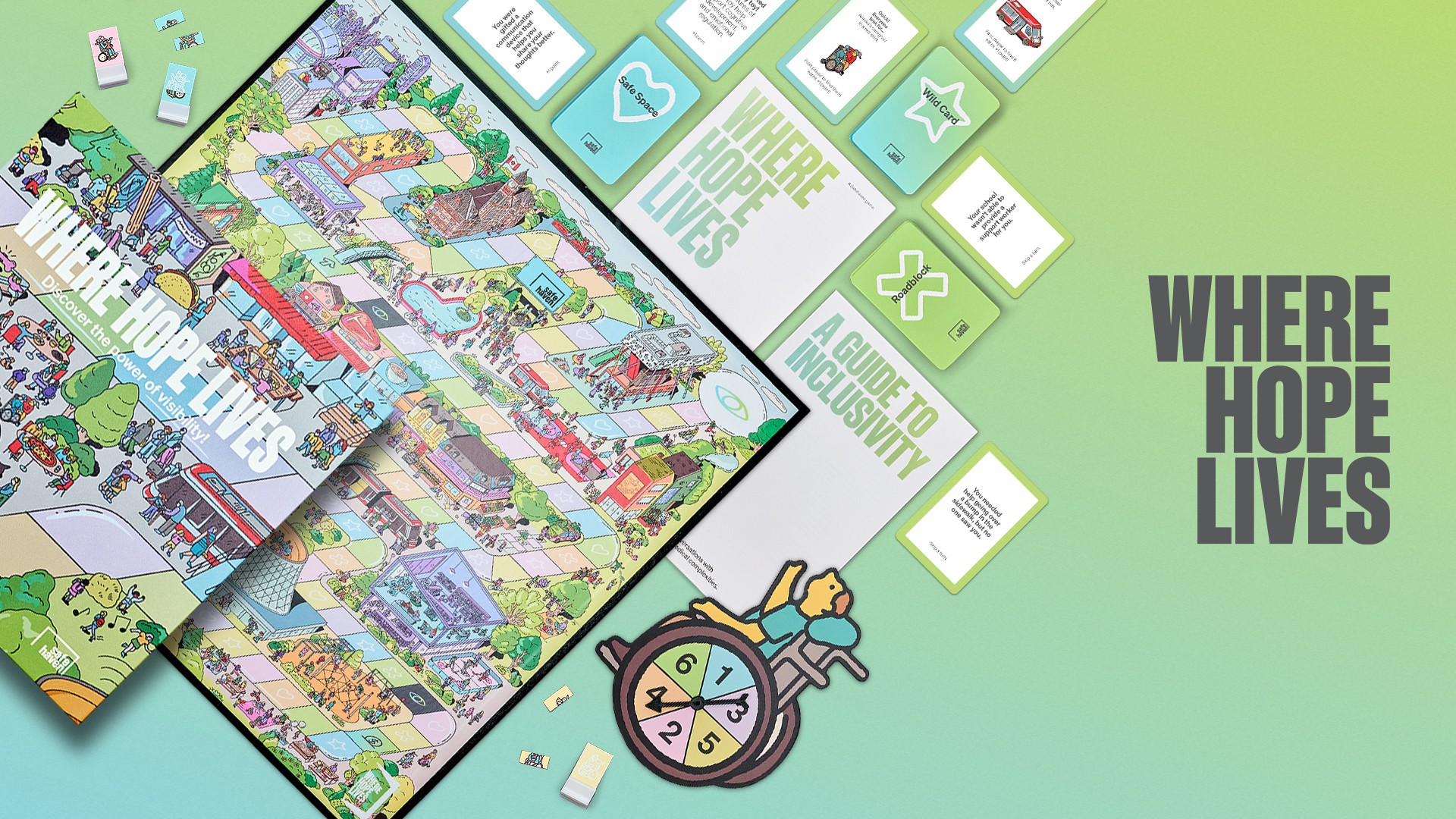
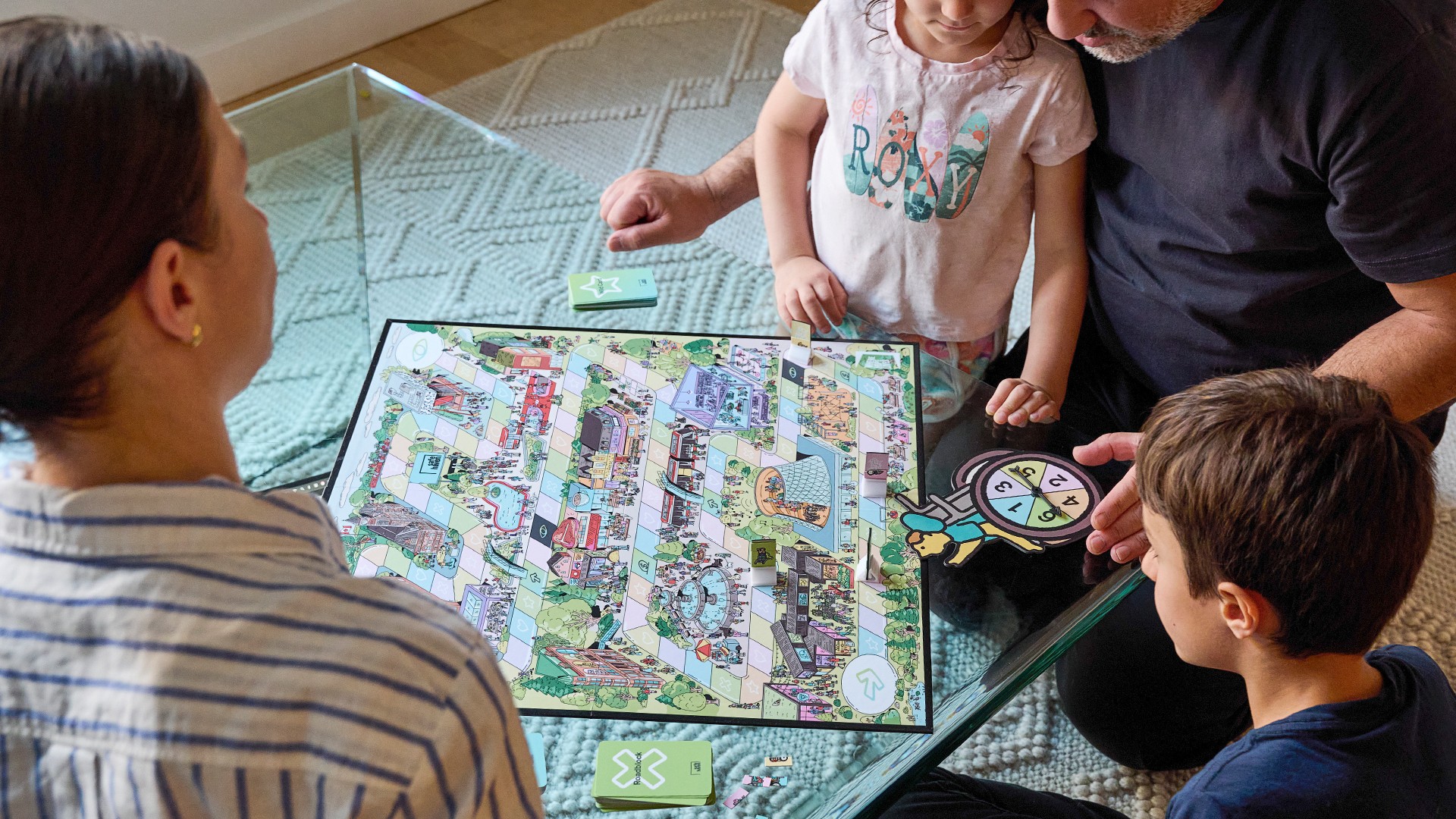
So, we created "Where Hope Lives," a fully illustrated board game families could use in real life. The game was designed to help parents and children understand and engage with medical complexity through play, using familiar environments and real-life scenarios to guide interaction. A companion parent guide supported these moments, offering simple language and prompts to help conversations unfold naturally, without shutting curiosity down.
Execution focused on use, not just exposure. The game was made available through the Safehaven store and distributed into environments where behaviour is actively shaped. It was introduced into 20 summer camps across the GTA, reaching nearly 18,000 children in peer-to-peer settings where social behaviour is formed and repeated. Influencers and advocates demonstrated gameplay in real homes, showing families how to engage, rather than telling them what to do.
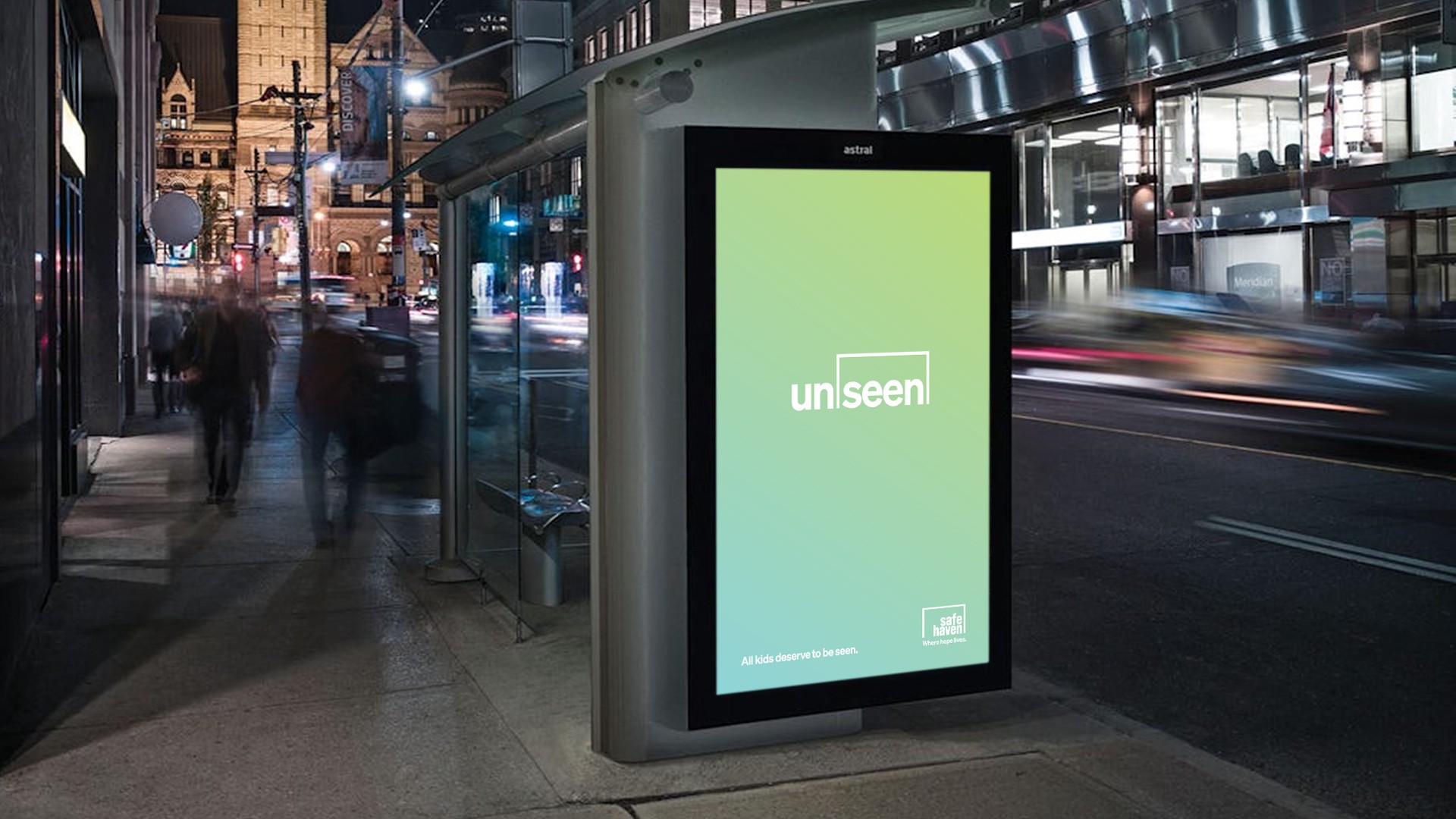
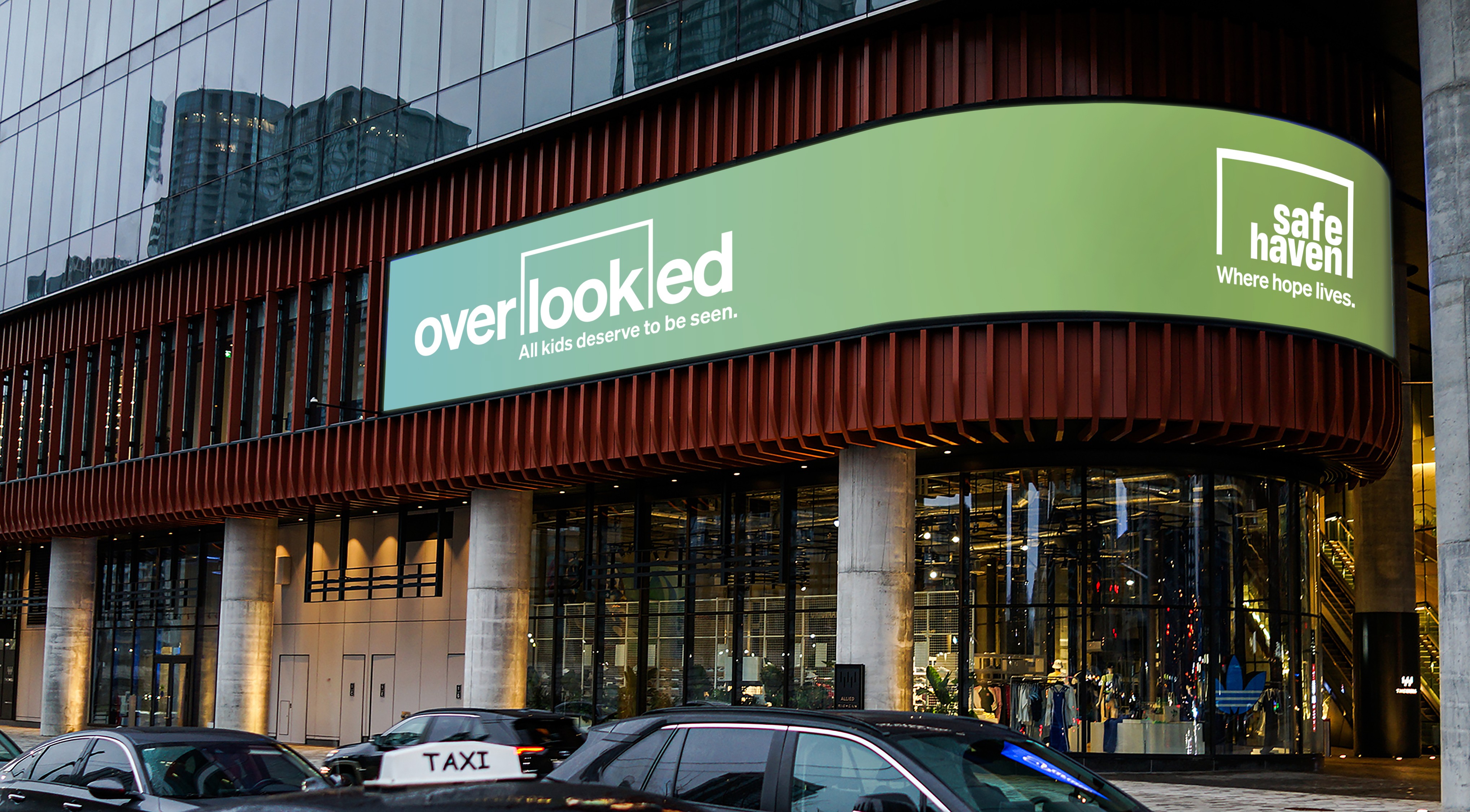
Out of home extended the idea by showing what happens when we choose to see. Using Safehaven's wordmark as a design system, we transformed familiar words like overlooked, unnoticed, and unseen. By placing the Safehaven house icon over parts of each word, we revealed a second meaning within them: look, notice, seen.
Together, the campaign worked across both private and public environments. In homes and camps, people built comfort. In the city, they were confronted with the absence of it.
The result was a shift not just in awareness, but in behaviour.
In 2025, the campaign generated 26 million earned media impressions across 67 placements, achieving broad visibility locally and extending to national broadcast. In a city of 3.3 million people, this equates to nearly eight times the population reached.
Engagement increased 88% year over year, demonstrating that the work resonated beyond a single moment. The campaign film alone delivered over 3 million impressions, outperforming the media plan by 40% and achieving 134% of planned video completions.
Total web audience increased 33% year over year, as more people actively sought out Safehaven. The Safehaven Store became a key participation platform, with traffic increasing 1,108%, creating a clear pathway from awareness to involvement.
This growth expanded the community itself. Safehaven's donor base increased 23% year over year, proving that the campaign didn't just reach people, it moved them to act.
The work also changed the pattern of engagement. Instead of peaking during a short holiday window, activity began at launch, sustained through summer and fall, and built into Giving Tuesday. This shift from seasonal spikes to sustained engagement reflects a deeper, more consistent connection with the audience.
By creating tools people could actually use, it helped turn inclusion into something that can be practiced in everyday life. Helping more people not just understand medically complex children, but see them as part of the world around them.
Credits
Safehaven TorontoThe Local Collective
Founder, Chief Creative Officer: Matt Litzinger
Founder, President: Kaitlin Doherty
Executive Creative Director – Design: Omar Morson
Account Director: Vallerie Traitsis
Account Executive: Shea McNeely
Producer: Andrew Schulze
Revolver Films
Director: Ross Allen
Producer: Craig Fleming
Executive Producer: Luc Frappier
Executive Producer: Richard Curran
DOP: Mat Barklay
Production Designer: Natasha Uhrig
Milo Casting:
Stephen Milo
Nimiopere
Editor: Christopher Chang
Assistant Editor: Bianca Bissada
Executive Producer: Jenna Edwards
Executive Producer: Julie Axell
Tantrum
Colour Artist: Dominik Bochenski
VFX Artist: Dominik Bochenski
Producer: Margarita Reynes
Executive Producer: Victoria Holt
Grayson Music
Creative Director: Ali Willa Milner :
Director: Mark Domitric
Audio Engineer: Brian Bernard
Executive Producer / Partner: Kelly McCluskey
Illustrator: Kathleen Fu
PR Agency: Heads + Tales
Media Agency: M&K Media
For submission inquiries, please contact strategyawards@brunico.com
.
For partnership inquiries, please contact Neil Ewen at newen@brunico.com.
For partnership inquiries, please contact Neil Ewen at newen@brunico.com.